Wednesday, July 27, 2011

Driving to Rome via Spoleto

From Cortina, the roads are very good. We enjoyed an hour or two of mountain scenery before we hit the foothills, and then began to cross the valleys of the large Po River Delta . With many miles to cover, we used the Autostrada a fair bit. It’s a system of fast two and three lane toll roads, and by the time we reached Rome I guess we had spent around 25 Euros ($40). The speed limit is 130 km/hr . We stuck to the right or middle lane and pottered along at about 110. Every now and then the speed crept up to 125 and even then the odd Alpha Romeo or Mercedes would streak by as if we were standing still. Italian roads don’t hug the contours of the land like ours do. If there’s a mountain, they tunnel through it. If there’s a valley, they bridge over it. And all towns are bypassed. Rest areas are every 50k or so, and always include ‘toilette’, gas stations, fast food and a self service resurant of some kind. In these, you go to the cashier and pay your bill, then you go to the counter and hand them the rceipt and the server fills your order.

Scenery is wonderful, including vast fields of sunflowers, all facing the sun, and in Tuscany and Umbria every hillside town is topped with a guard tower and usually a small walled castle.

The drive took most of the day. We made a detour which added an hour or two to our day but we wanted to see Spoleto where Merrie had spent a couple of summers playing in the orchestras of the
“Festival of Two Worlds”, initiated by composer Gian Carlo Menotti. The festivals run annually in both the old (Spoleto, Umbria) and new (Charleston, South Carolina) worlds. We looked around the beautiful town for a half hour and enjoyed a nice dinner in a little restaurant where the owner/hostess made up a few plates of what she had on hand. Delicious.

The Castle (Menotti's home) and church bell tower from the streets of Spoleto


Giant poster for the Spoleto  Festival
By the time we reached the Periferico, the 80 km ring road that surrounds the greater Rome area, it was getting dark. Luckily the road on which our hotel lay was a major one and showed up on the exit signs. Also, the traffic at that time of day was light.

These 'Umbrella' pines are everywhere in Rome - an important source of shade.

The next morning we set off to find the studio of Claude Lebet, a well known (in Italy) violin maker. The plan was to rent instruments for the next two weeks. A very different traffic scene - scooter and motorcycles continually zooming by on both sides of us between the lanes of moving traffic. If you left a car length of space ahead, there would instantly appear three scooters abreast in front of your bumper. I quickly learned that there seemed to be a rhythm to the apparent chaos: if you just keep a steady speed and don’t swerve or react to the swirling killer bees, you become a constant to them and they take care of all the swerving and reacting among themselves. Still, it’s amazing that the sides of streets aren’t littered with road kill (drivers) and yard sales (motorcycle parts). Important rule: Don’t hesitate.

Then the parking. The saying is that Romans don’t park their cars, they abandon them.   Along some blocks, there were more double parked than single parked vehicles. Suddenly (actually after half an hour) we came upon an empty space. OK, three quarters of our car was covering the sidewalk, but that’s how everybody else was parked so we (I) figured we’d be all right for a half hour.

Thanks to the kindness of Dave in Denmark and Dr. Allan deCaen in Edmonton (a former student and an excellent violist!) we became aware of a fine violin shop near the Roman center, "Atelier (studio) Claude Lebet". What a pleasure it was to enter the workshop of a modern day master luthier. Rather than student instruments, which we were expecting, Rudolfo (number two man) offered us a violin and viola made by maestro Lebet himself. We then learned that they could not be picked up until the next day. And so, disappointed, we headed off to find our car not towed or ticketed and returned it to the rental agency which had an outlet two blocks from our hotel. (more horseshoes) In Europe, it’s fairly common to rent a car in one location and drop it off in another with no drop-off charge. It may have helped that we drove from Trieste (lower demand) to Rome (higher demand).


Our friends from the Port Angeles symphony were due to arrive that afternoon, so Susan went to the hair salon and I cooled off in the room. That evening, we all joined up for the first official group activity, a welcome dinner in a restaurant with a very nice view and bottomless wine bottles included.

 Italian beauty fresh from the Salon

 Don't let the computer in this pic fool you; internet service in this country is abominable. 
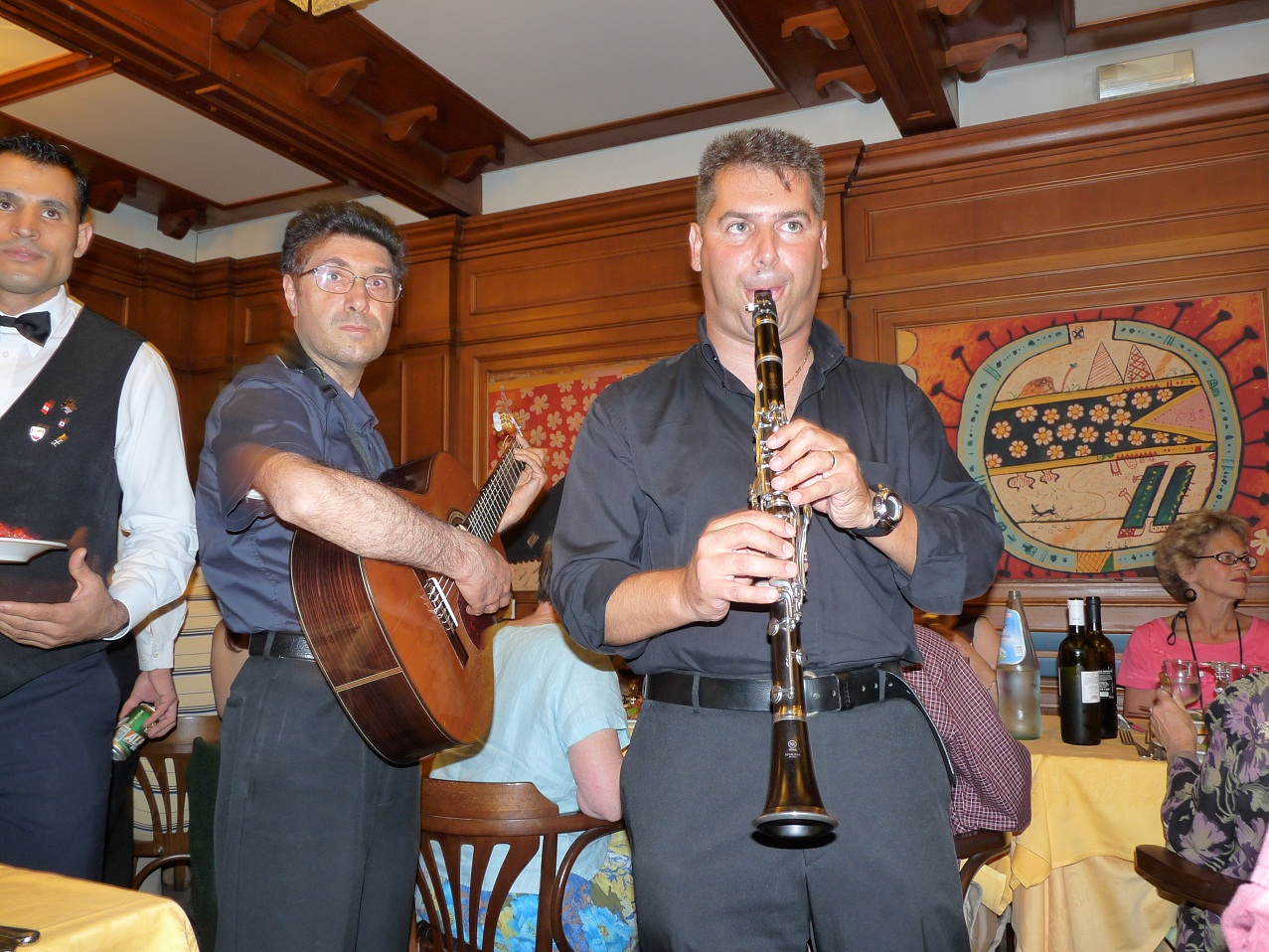
The band at our group dinner

Our tour leader, Gay.  All the women received a rose at the end of the dinner.
When I asked the waiter what do the men get, he said, "For thee men, Coffee!"

Friday, July 22, 2011

I Dolomiti Ultimo (IV)


A thunder and lightning storm developed in the evening, but by morning it had cleared off to make room for another perfect day. Off to our third via ferrata - the most challenging and highest trail yet (still, only rated 2B). It’s not very long but is almost all at altitude above 10,000 feet. Following ridges near the top of Monte Cristalo, the route is named Via Ivan Dibona, after a famous mountain guide. First we had to take two lifts (funivie) up Cristalo Mountain. The first was a quad chairlift which was sleek and modern; the second was a relic from the 1956 Olympics… looked like little dangly Chilean miner rescue pods that take only 2 standing people. We stopped for coffee at mid station to acclimatize to the altitude and recall how it’s been a pretty good life . . .

At the top, much higher than the Olympdownhill ski runs and WAY above treeline, we geared up and took a little ‘via ferrata’ scramble up a ridge, through some more tunnels, up some iron ladders and over the longest suspension bridge in the Dolomites trail system. What a view. Incredible. We took lots of photos, but it really is impossible to capture the feeling. And who lives up there, besides the barrista/bartender and innkeeper of the rifugio? These amazing birds called Alpine Choughs (chuffs). Look a bit like crows or ravens, but with yellow bills and orange feet. They nest in the rocks, eat who knows what, and have the most musical crow caw you ever heard.

As the tin can that I was riding in (Susan and Louise clutched each other courageously in the following pod) swayed and wibbled its way onto the landing deck, I noticed a yellow dog barking and racing around each pod as it arrived, following it desperately around the platform until the pod with descending passengers sailed off over the edge for the return journey. “Don’t go!, Don’t go!” (translation from “Bark! Bark-bark! Bark!”)


These photos look better enlarged.  Click once to enlarge a bit; twice for more detail.


Our Italian lifty explained as I stepped in, that this was the last year of service for these pods.  I thought I heard him mutter as he secured the door, "better you than me".


Fastest 3.000 feet I ever 'climbed'.
Alpine Choughs


Refugio at 10,000 feet.


No, we were not swinging.  It just hangs a bit funny but feels very solid.
Above the bridge

Susan went back to join Louise and I carried on for about 15 minutes along a fantastic ridge.  Hope to return to do the whole thing one day.

True to form, we squeezed every moment out of our time on this fantastic mountain, ….had a cold one at the midway point rifugio, and rode the second-last chair down before they closed the lift for the day.


Tomorrow, we drive 8 hours to Roma, where we meet the our Port Angeles Orchestra Tour the following day, to begin the musical leg of this tour.


 Cafe next to our hotel


Farewell to Cortina

I Dolomiti III

Next day, our second via ferrata was at the Falzarego Pass, a crucial strategic area during WW I when the Italians were fighting Austrians for control of high ground. The Lagazuoi (La-ga-ZOO-oy) Tunnels, involved hiking up a ton of switchbacks and then climbing the rest of the way inside the mountain through a system of tunnels which were built during the first world war to protect the forces that were guarding the pass. Many side tunnels and rooms still contained equipment and left over materials from those days. Absolutely incredible. Incredible also, was that we old farts were still able to do a five hour climb between 6,700 and 9,000 feet altitude! With rented helmets and our own headlights and harnesses, we climbed an elevation gain of over 2000 feet . Susan and Louise were inspired to stay the course because of the best part ahead: the cable-car ride back down! …. The Italian wine and smoked salmon with giant do-it-yourself bocconcini/tomato/greens Insalata Caprese also went down very well as dinner in our rooms. We had now discovered the supermarket and were no longer slaves to over-priced, veggie-challenged dinners.


My favourite mountain flower, Alpine Forget-me-not


 Many switchbacks

Switchbacks done, now for the tunnels


 The tunnels were long.  They took about an hour.

A few "windows "along the way gave us a bit of variety


 The moles emerge

Out on to the ridge

 This tiny flower, less than an inch high, reminded me of Moss Campion

Grandma  on the mountain

Orange lichen about the size of a loonie takes about 100 years to grow this much. 
Long way down 
But here comes our ride, La Funivia


Thursday, July 21, 2011

I Dolomiti II


click to enlarge


In Cortina, the bell tower across the street made sure we were up by 7:00 a.m. each day. On our second morning, we were awakened even earlier by the sounds of human industry below our window. A giant market was being set up in the streets and alleys, very colourful. It took over the whole town, selling everything from produce to clothes to books to useless trinkets. I bought a hat, having left my worn out Tilleys at home. The market filled the roads for eight or ten blocks and then was all packed up and gone by 8 p.m.


Doesn't sweep too well but it flies great!

From near the centre of town you can take a funivia (foo-NEE-vee-ah), a gondola similar to Grouse Mountain’s, right to the top of one of the local ski hills. Susan and Louise: ‘now THAT’s mountain climbing!’ And at the top? A rifugio for a cold drink on the deck following all that exertion!   After yesterday’s hike, they figured it was best to enjoy a bit of a rest day and I left them there to enjoy their medio litro (half litre) of vino while I explored a few ridges with nice views over looking the town and valley from about 8,000 feet.

Cortina d'Ampezzo

Click to see S & L on the left corner of the deck.


An old mining company building 


Next, driving to Lago Misurina and it’s smaller sister lake made for a beautiful side trip for us. The path around the little lake is easily walked, and provided fabulous foto fodder, as well as a new bird or two. Slavonian Grebe sounded all exotic and exciting but the scientific name proved it to be the same as what we call Eared grebe.


Old wooden ski jump from 1956 Olympics